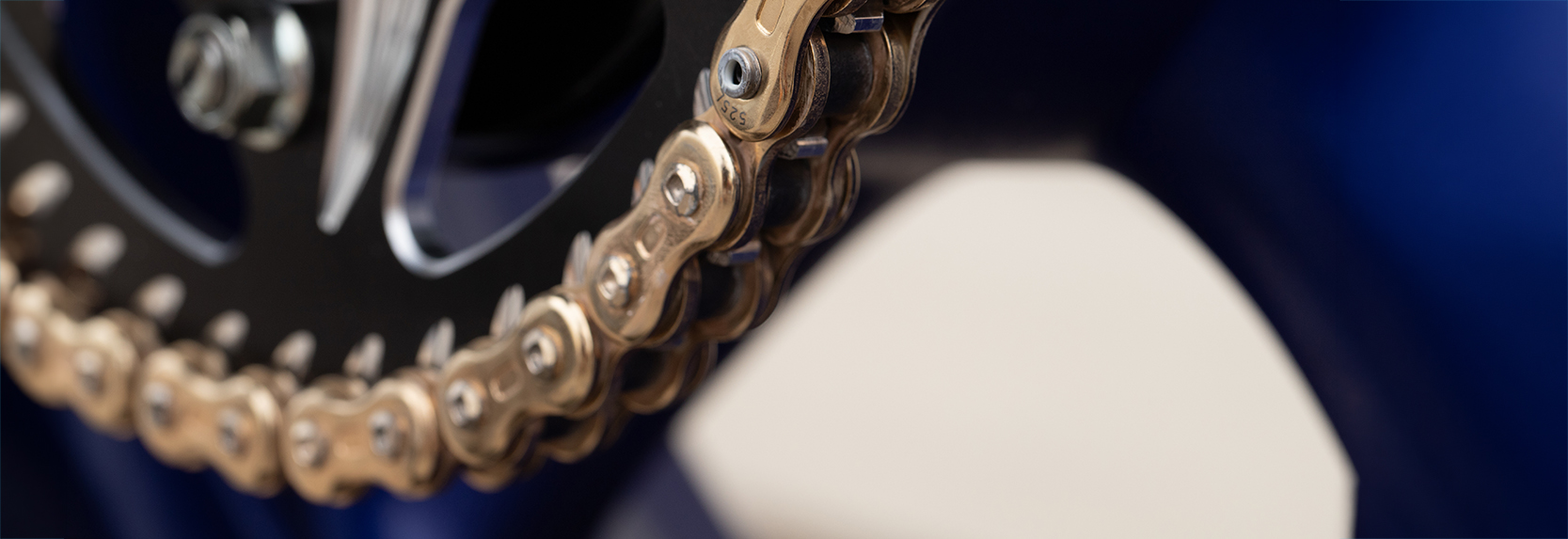

Sprocket Buying Guide
Sprockets play a huge role in how a motorcycle feels and behaves. That makes choosing the right gearing setup crucial to get what you want from your bike. This guide serves as an introduction to help you make an informed decision when choosing your next set of sprockets.
Sprocket Pitch
The thickness and spacing of the sprocket teeth define the pitch. Example: 530 pitch is thicker than 520 pitch. The 420 pitch has more teeth per inch than the 520 pitch, but they are the same thickness.
For most people, sticking to the OEM pitch works just fine. For people looking to ditch some extra weight, they might convert their bike to a smaller pitch, i.e., 525 to 520. This saves rotational weight on the sprockets and chain. This will subsequently make the bike feel snappier on the throttle and increase total rear-wheel power output.
When converting pitch, the front and rear sprockets MUST be the same pitch as the chain to ensure they work together correctly.
Aluminum vs Steel
Another way to reduce rotational weight is to change the material the rear sprocket is made of. Steel is the traditional choice for manufacturers. It is highly durable, but that comes at a price of being very heavy. For the everyday rider, a steel sprocket will be adequate, providing reliability and ease of maintenance. Generally, a steel sprocket is expected to last 2x as long as an equivalent aluminum sprocket.
Aluminum sprockets solve the weight problem by being half the weight of a steel counterpart, but are softer, requiring more care and attention to achieve proper performance. Aluminum sprockets are very sensitive to chain cleanliness and tension, so bikes with aluminum sprockets should have the chain cleaned and tensioned every 300-400 miles.
Bikes used for road racing, motocross, flat track, drag racing, and roll racing will choose aluminum for the massive weight savings it provides, knowing that they must maintain it properly and potentially replace it more often.
Anodizing vs Hardcoat
All Vortex aluminum sprockets have a finish applied. Standard silver sprockets have a clear coating to help prevent oxidation. The colored sprockets have an anodized coating that provides the same protection while adding some personality to your bike.
These finishes are applied before the sprocket is cut, giving our sprockets the iconic two-tone machined look they’re known for. We currently offer sprockets in silver, black, blue, red, green, purple, orange, and gold.
Our F5 Hardcoat, on the other hand, has a different purpose. Applying after the sprocket is cut allows the Polytetrafluoroethylene (PTFE) coating to be on the sprocket’s teeth.
PTFE has a much lower coefficient of friction than raw aluminum and is also wear- and heat-resistant. This gives our hardcoat sprockets a longer lifespan than standard aluminum and less drivetrain friction loss.
CAT5 vs V4
In 1995, we released the CAT5 sprocket design, and since then, it has become the industry’s most iconic sprocket.
In 2026, we decided to make a version that is even lighter and more performance-focused. Thus, the V4 was born, boasting a 10-15% reduction in weight without sacrificing any strength. This is done with a new pattern that focuses on the best structural integrity and machined faces on both sides.
The CAT5 is not going anywhere, but we will be offering the new V4 design for the most popular tooth counts and wheel fitments.
Tooth Count
Deciding what gearing to run is by far the most daunting and confusing part of choosing sprockets. To understand the effect of changing the gearing, we need to know the ratio between the front and rear sprockets.
A bike with a 14T in the front and a 45T in the rear will have a ratio of 3.21 (45 divided by 14). If the ratio goes up, the bike will have more torque or “bottom end” but a slower top speed. If the ratio goes down, the bike will have more top-end speed but lose some low-end power.
A common change is to go down one tooth in the front. This will make a noticeable difference in the low-end performance of a bike. This is useful for a bike like an inline-4 that doesn’t have much low-end torque.
On the other end, a bike with a parallel twin might have plenty of torque but lack a higher top speed, so going up a tooth in the front will give it that higher top speed by sacrificing some bottom end.
Similar changes can be made, on a smaller scale, by changing the tooth count on the rear; the changes are inverted. A 1 tooth down in the front is equivalent to 2-3 teeth up in the rear.i 45/13 = 3.46 vs 48/14 = 3.43
For someone looking for a small but noticeable difference, starting with a 1 tooth difference in the front or 2-3 in the rear is a good starting point. But if you want a larger, more dramatic change, you can change the front by 1 and the rear by 2-3 to get a much bigger difference.
Sprocket Maintenance
Keeping the chain and sprocket clean is vital to a long life. If dirt and debris are left on the sprockets, they will wear out much faster than they should.
Keeping them clean helps maintain the surface finish and prevents rust or oxidation.
Cleaning the sprocket and chain should be done every 300-600 miles on street bikes and after every ride on dirt bikes to maximize chain and sprocket life.
Need Help Choosing?
If you still have questions about what chain is right for your bike, contact Vortex Racing at (800) 440-3559, Monday through Friday, 8:00 AM to 5:00 PM MST, or email [email protected].